Blog
The five levels of a working personal system
2 min read
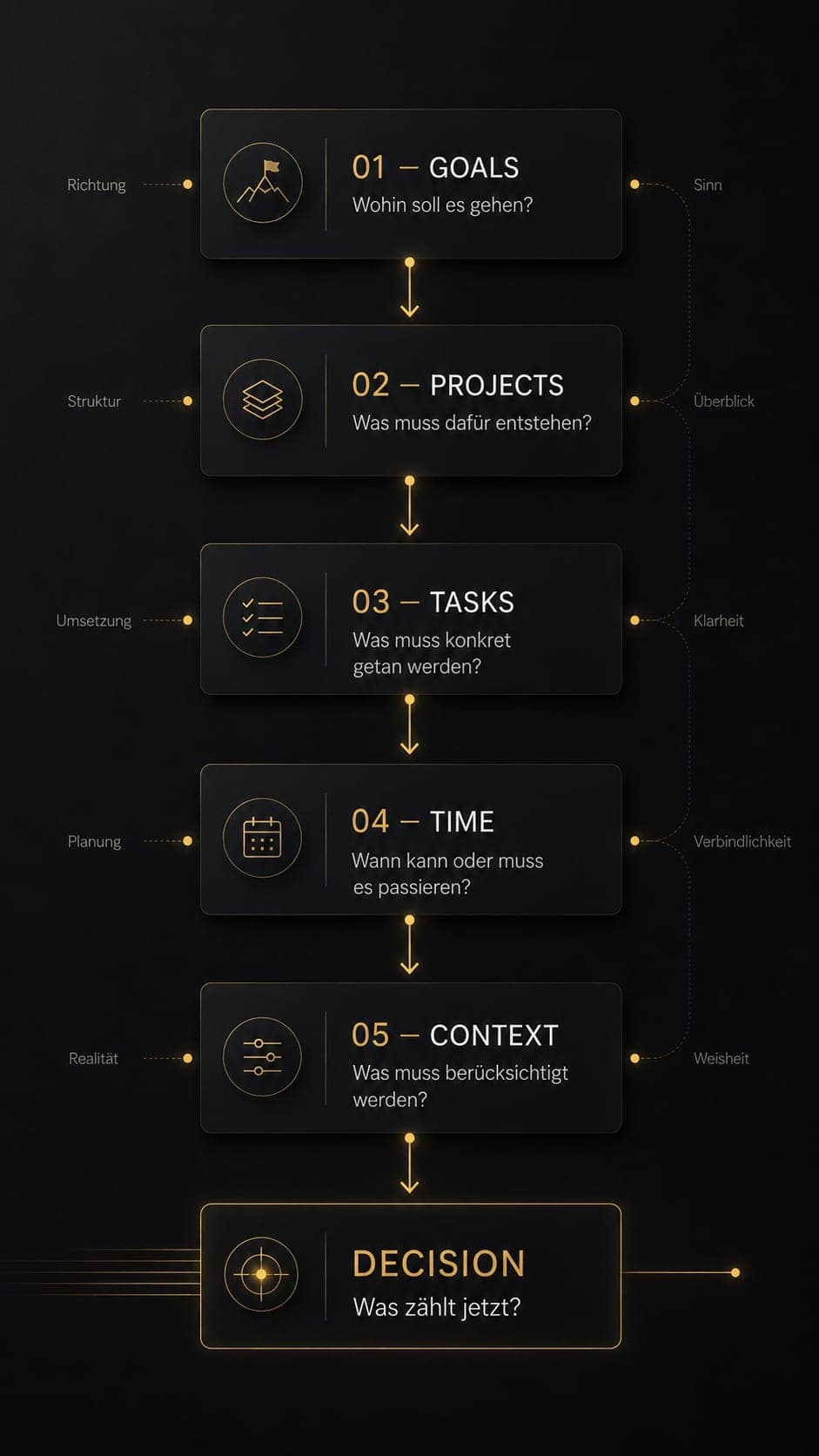
Goals, Projects, Tasks, Time, and Context build on one another — each level brings you closer to the one decision that matters right now.
A single list can’t show how work actually fits together. A working personal system needs several levels that build on one another — each brings you a step closer to the one decision that matters right now: what you do next.
Level 1: Goals — the direction
A goal answers the question of where you want to go in the first place. Without this level, every further task has no reason to exist — it just hangs in the air. Goals don’t have to be huge; they only have to be concrete enough to place projects and tasks beneath them in a meaningful way.
Level 2: Projects — the frame
A project bundles everything that belongs to a goal into a manageable undertaking with a beginning and an end. It translates an abstract goal (“win more customers”) into something tangible (“launch the new landing page”). Without this level, a goal remains an intention, not an undertaking.
Level 3: Tasks — the concrete steps
Only at this level does something become truly tangible: a single, clearly defined action that can be completed in one sitting. Many systems start directly with tasks, without the link to project and goal — and that’s exactly when tasks lose their connection and turn into a plain to-do list.
Level 4: Time — when there’s really room for it
A task can be as important as you like — if there’s no realistic window of time for it, it stays theory. This level connects tasks with the calendar and with the focus time that is actually available, instead of simply writing them on a list and hoping the right moment will arrive on its own.
Level 5: Context — how everything works together
Context is the level that ties the other four together: Which goal is most urgent right now? Which task within it has the next deadline? Does it fit into the time that is actually free today? Only when these questions are answered together does a single, comprehensible priority emerge — instead of five independent lists that have nothing to do with one another.
Why the order matters
These five levels only work together, not in isolation. A goal without tasks remains an intention, a task without a goal loses its meaning, and time without context becomes mere scheduling. Why a plain to-do list fails at exactly this, we have already described elsewhere. How Rise Beyond connects these five levels, the overview of how it works shows.
If you want to experience for yourself how this feels in everyday life, you can apply for early access to Rise Beyond.
Organize less. Act with clarity.
Join the closed beta