Blog
Why your to-do list doesn’t solve your real problem
2 min read
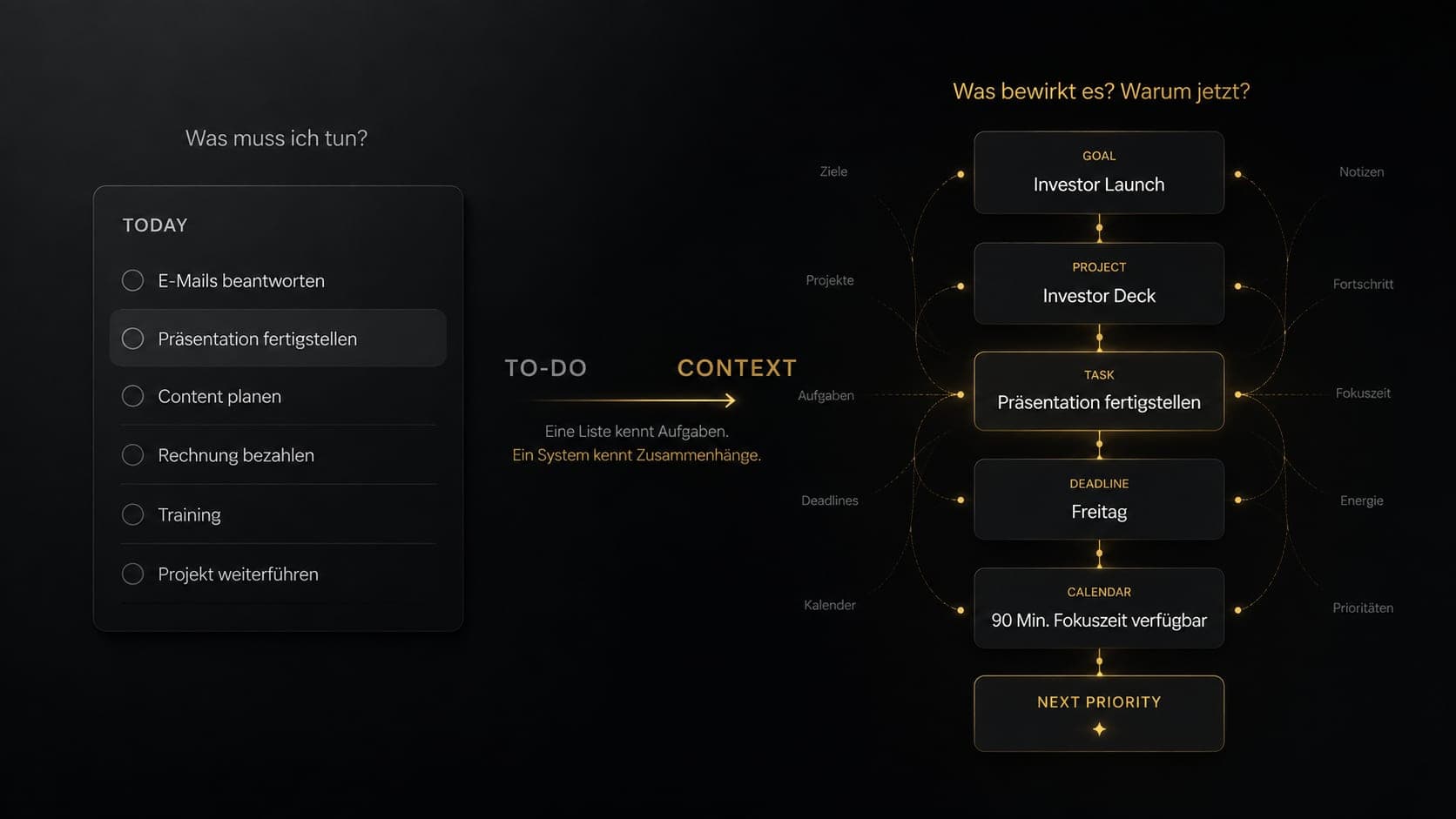
You have tasks, projects, and appointments — and still you often lack the answer to a simple question: What should I actually do right now? The problem isn’t a lack of organization, but a lack of connection between your information.
Most people who keep a to-do list don’t have too few entries — they have too many, without knowing which one matters right now. So the list itself isn’t the problem. The problem is what it doesn’t show.
The real problem: missing connection, not missing organization
At its core, a to-do list is a flat collection of lines. Every line looks the same, whether there’s a deadline in two hours behind it or a vague idea that can wait until next month. The list itself says nothing about why an entry is there — it only records that it is.
That is exactly what makes it unreliable once more than a handful of tasks pile up. Without a connection to a goal, an appointment, or a window of available time, there is only one way left to sort the list: by gut feeling, by the order in which things were added, or by whatever seems loudest right now.
An example: the same task, two very different priorities
Take a simple line like “Create invoice.” On a to-do list, this entry always looks the same. In reality, it isn’t: for a client who has to pay in three days so a larger project can keep going, this task is urgent. For an internal process without a deadline, it isn’t. The list doesn’t know this difference — you have to call it to mind again every single time.
What’s missing: the link to goals, appointments, and time
For a task to be truly placed in context, it needs a link to a goal or project (why does it exist at all?), a link to time (is there a deadline, and does it fit in the calendar?), and a link to the focus time currently available (is there actually room for it right now?).
Four questions a plain list can’t answer
- Why is this task important in the first place?
- How urgent is it really, compared to everything else?
- Does it fit into the time that is actually available right now?
- What exactly happens if it isn’t done today?
Context instead of a list
These four questions can’t be answered with more discipline or yet another app for checking things off — they need connection: the link between task, goal, appointment, and time. Rise Beyond connects exactly these points, instead of collecting them side by side in yet another list. This overview shows what that looks like in practice.
If you want to know how this idea carries over to a complete system — not just to individual tasks — it’s worth taking a look at the five levels of a working personal system.
If you want to experience for yourself how this feels in everyday life, you can apply for early access to Rise Beyond.
Organize less. Act with clarity.
Join the closed beta