Blog
Why classic to-do lists fail in a complex life
4 min read
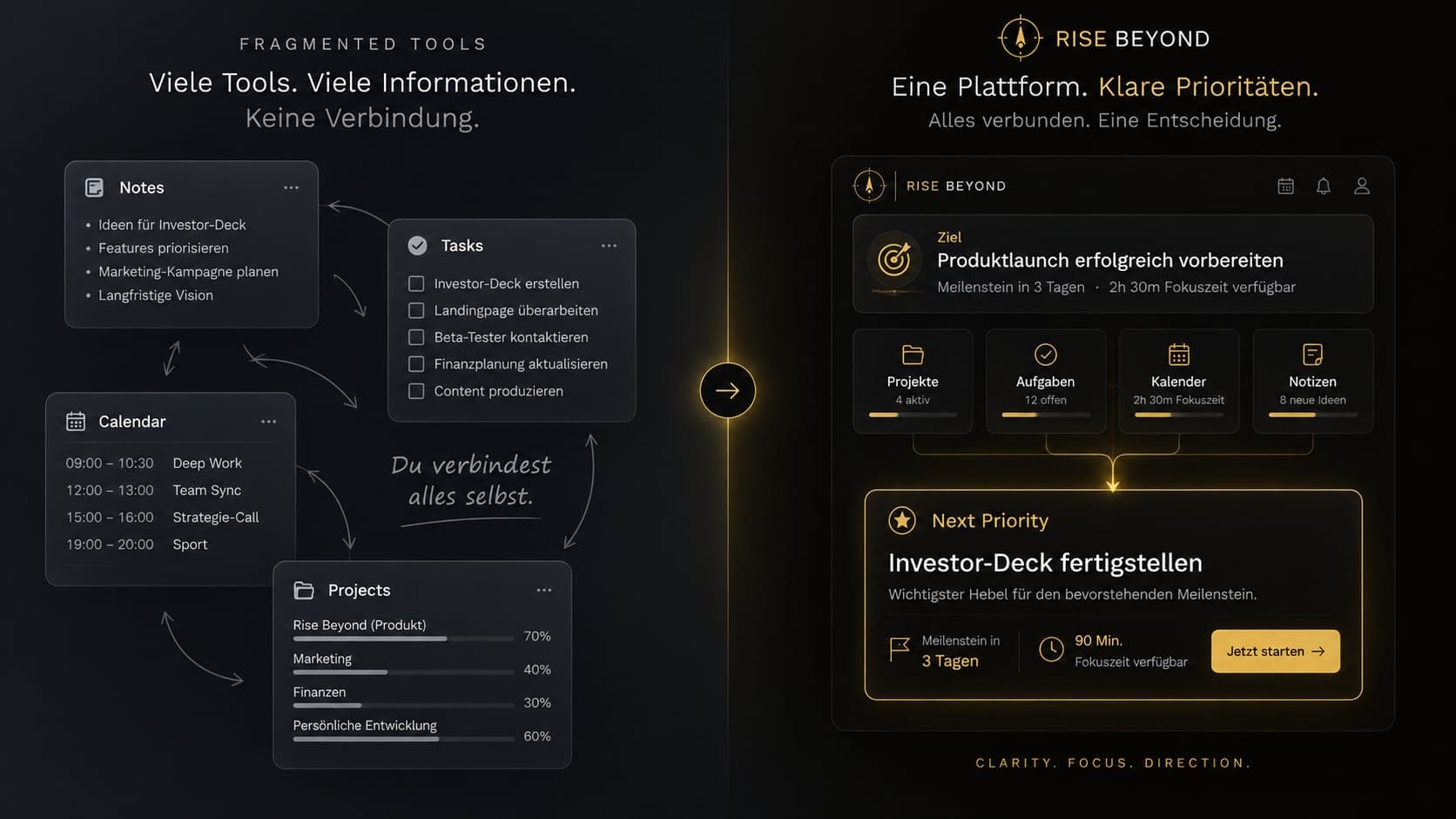
Job, family, a project of your own, health — once several areas of life run at the same time, a single flat list becomes a problem. Not because it gets too long, but because it knows no areas.
A job, a project of your own on the side, family obligations, a health goal — most lives no longer run in just one area. Still, almost everything ends up in the same single to-do app, as if it were one continuous stream of tasks. The problem doesn’t show up right away — at first, everything still fits easily into one list. It only creeps in as the number of areas running at the same time grows.
A list knows no areas of life
A classic to-do list basically knows only one distinction: done or not done, at best sorted by date. It has no built-in way to say that one task belongs to the job, another to the family, and a third to your side project. An important project deadline and “schedule a dentist appointment” sit side by side on the same list, visually equal — even though they belong to completely different contexts and should really be judged by entirely different standards.
Why this becomes a problem as complexity grows
With only a few simultaneous commitments, you hardly notice — a short list can be sorted in your head even without structure. But as soon as several areas of life run in parallel, the mental effort grows of first assigning each individual task before you can even decide whether it matters right now. A parent who is coordinating a job, a renovation, and a child’s school routine at the same time sees a follow-up question about the renovation quote on the same list right next to “pack lunch” — technically both are a task, in substance not remotely comparable, and yet every morning it has to be decided anew which of the two takes precedence.
Fragmentation is not a solution, but a symptom
The obvious reaction is to use a separate tool for each area of life — one app for health, a separate family calendar, its own list for the side project. That relieves the crowding on the one list, but creates a new problem: now no single tool understands the whole picture. Exactly the comparison that is constantly needed in real life — weighing a family appointment against a work deadline — doesn’t become easier but impossible, because both sides live in separate systems that know nothing about each other.
A second example: the same person, different roles
Even without a family, a single person with several roles is often enough. A self-employed person often has not just one area but several at once: the business itself, their own continuing education, private obligations. On a single list, “Invoice for client X” and “Continue online course” look visually the same — both a line with a checkbox. In reality, one belongs to an ongoing, paying project, the other to a long-term but unpaid goal. Without this distinction, the paid project almost always wins — not because it’s more important, but because it’s louder and calls for attention again by itself every week.
Why time remains the common denominator
However different the areas are in content, in the end they all compete for the same limited time. That’s exactly why separating by area alone can only be half the solution: without a shared view of time as a whole, you can never honestly answer whether there is currently enough room for all areas at once — or whether one of them regularly comes up short without anyone even noticing, because in its own isolated tool it is simply less visible than the louder, more urgent areas.
What a complex life really needs: structure, not more lists
The real solution is neither a single undifferentiated list nor a collection of separate apps per area, but a structure that can do both at once: each area of life gets its own frame of goals and projects, but all areas share the same calendar and the same available time. That way, areas stay distinguishable without making a real comparison between them impossible. How goals and projects can form this structure, we describe in a separate article — the same logic applies to a single area as to several at once.
Separation and connection at the same time
A flat list offers connection without separation — everything lands in one place, but without distinction. Several separate apps offer separation without connection — each area on its own, but no shared view. Both extremes each solve only half of the actual problem, and most people simply switch back and forth between them over time without the underlying problem going away.
What’s needed instead is both at once: clearly delineated projects and goals for each area of life that can still be compared in one place when a real decision is due. We describe exactly this interplay in the overview of how Rise Beyond works.
If you want to feel for yourself what several areas of life in one place feel like without losing their separation, you can apply for early access to Rise Beyond.
Organize less. Act with clarity.
Join the closed beta