Blog
You don’t need more time. You need fewer competing priorities.
2 min read
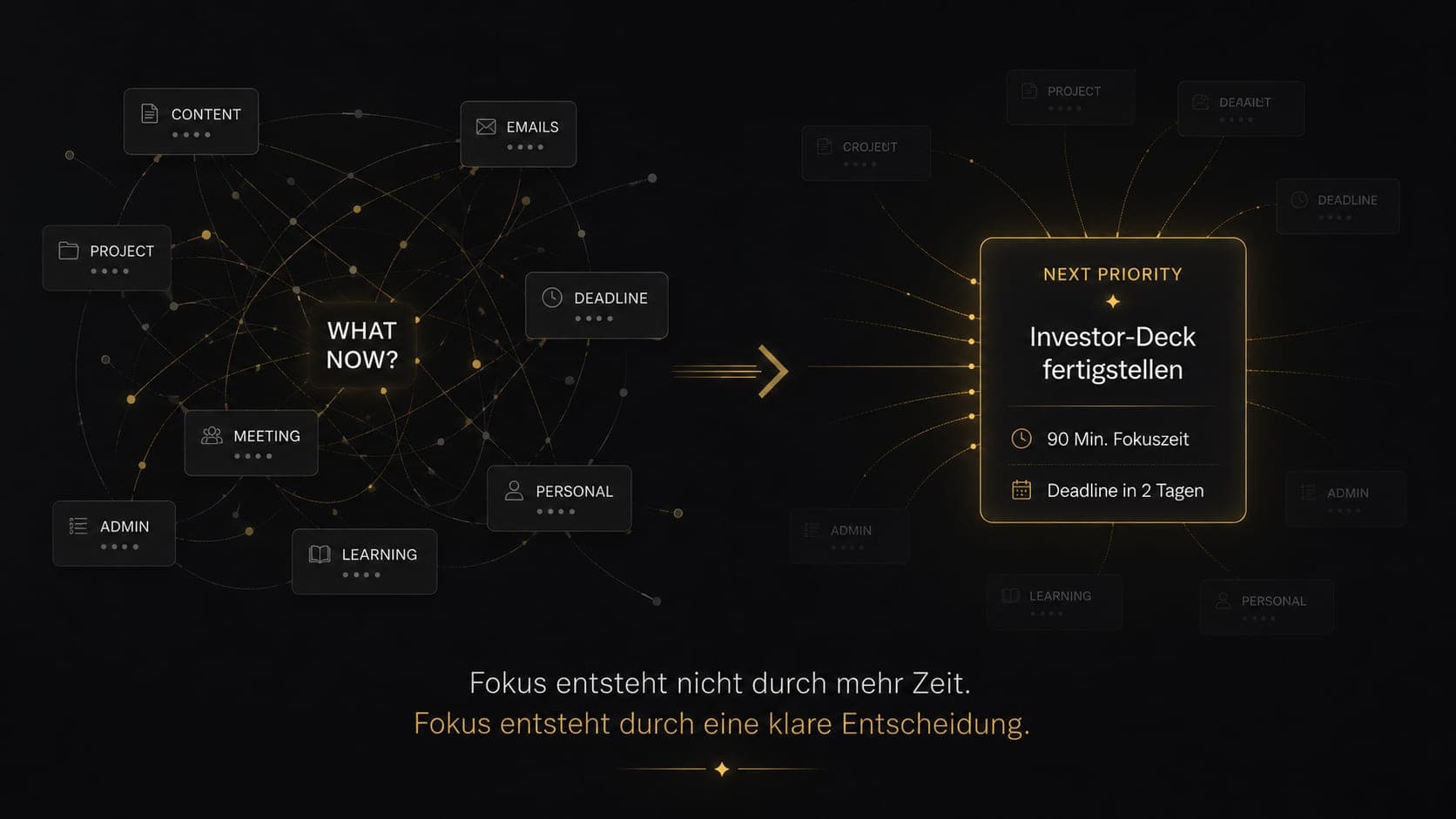
Focus doesn’t come from more time, but from a clear decision about what truly matters right now — and from seeing which of your many tasks takes precedence.
It feels like a time problem: the day is full, and yet at the end you’re left with the feeling of not having accomplished anything truly important. The real problem is rarely too little time. It’s that too many things claim to be the most important at the same time.
Why suddenly everything seems equally important
As soon as goals, projects, and tasks sit in separate lists, notes, or tools, they lose their ranking relative to one another. Each single thing seems urgent on its own — there’s simply no way to compare them side by side. Without that comparison, every request sounds equally loud.
An example: three priorities, one calendar
A client meeting needs to be prepared, an invoice is overdue, and an investor is waiting for an update. Looked at individually, each of these three tasks is understandably important. Together, though, they create a feeling of overwhelm — not because there’s no time to get all three done eventually, but because it’s unclear which one comes first and why.
Fewer priorities instead of more discipline
The obvious reaction is to prioritize harder — another matrix, another ranking system. But the problem rarely lies in a lack of prioritization technique. It lies in the fact that prioritizing has to happen from scratch, in your head, every single time, without a real comparison between goal relevance, deadline, and available time.
What “competing priority” actually means
Two things don’t compete because both are important — they compete because nothing shows which of them matters more right now. As soon as that comparison becomes visible, the competition disappears: what remains is a clear order instead of a feeling of “everything at once.”
This is exactly where a system like Rise Beyond comes in: it doesn’t reduce the number of your tasks, but makes visible which of them truly takes precedence right now — based on goal relevance, time pressure, and available focus time. How this interplay works as a whole is the foundation of the entire system.
And if you already know which priority matters right now, but not which specific task comes next — that’s exactly what this article on prioritizing individual tasks is about.
If you want to experience for yourself how this feels in everyday life, you can apply for early access to Rise Beyond.
Organize less. Act with clarity.
Join the closed beta