Blog
Organization apps compared: what sets a system apart from a list
4 min read
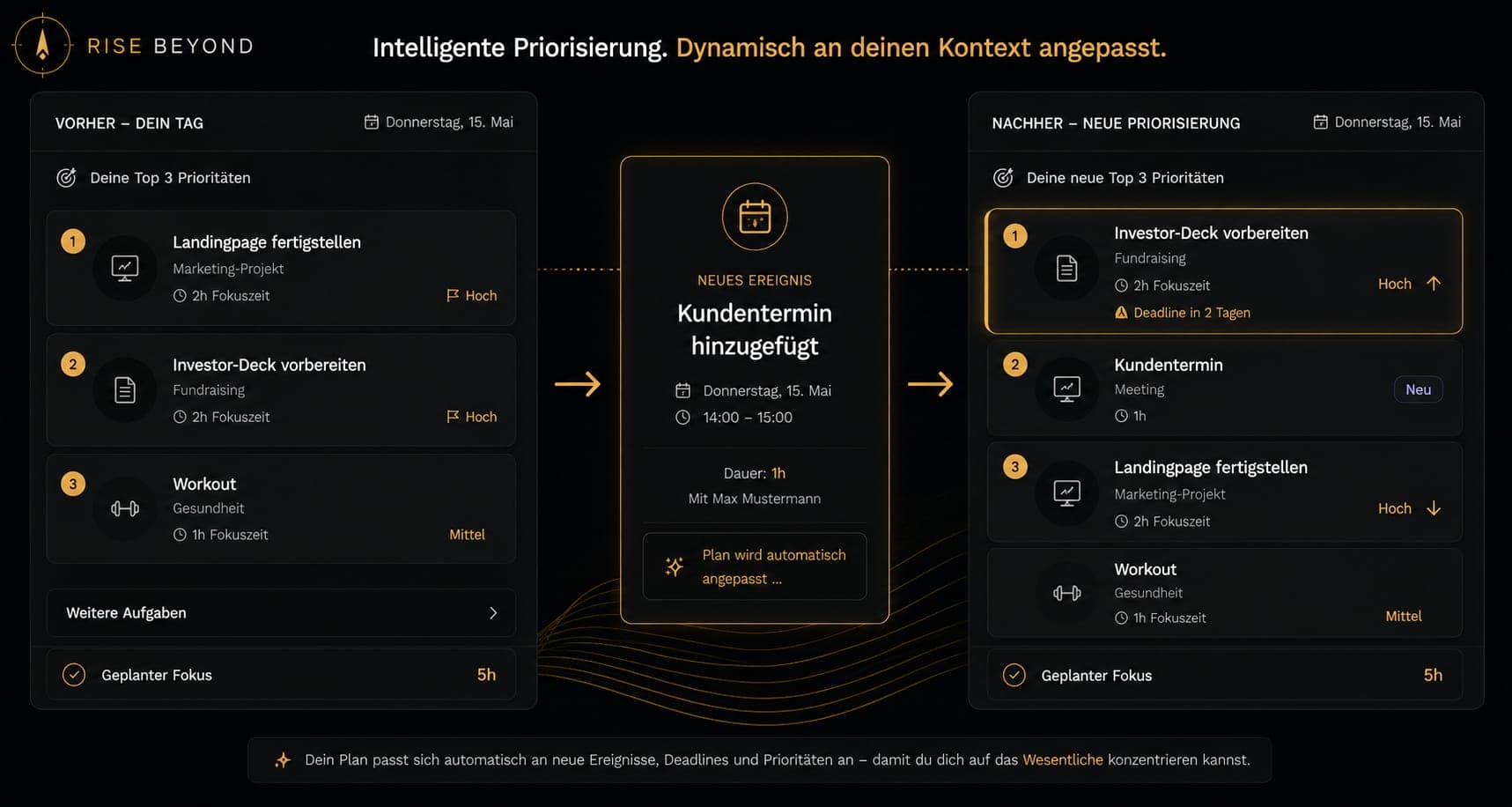
What makes a good organization app? Most tools only store what you want to do — a real system also understands why it matters and what has priority right now.
Anyone searching for an organization app is rarely really looking for yet another app. Behind it there is usually an unspoken question: Why does my current system still feel chaotic despite all its features, even though I’ve already tried the third or fourth app? The answer rarely lies with the app itself, but with what kind of tool it is in the first place.
What most organization apps actually do
Most apps in this space are, at their core, very good at storing things: notes, tasks, appointments, reminders. That is a real, useful function, and it’s often fulfilled reliably — but it only answers what exists, not why it exists or how it relates to everything else. Two stored tasks sit side by side, regardless of whether one is crucial for an important goal and the other is pure routine.
The real question: list or system?
A list stores things in parallel — side by side, with no relationship to one another. A system stores things in relation to one another: a task belongs to a project, and the project serves a goal. Why a plain list fails at exactly this point, we have already described at length. The distinction between list and system is rarely obvious at first glance at an app — many lists disguise themselves as systems with pretty interfaces, tags, and filters without structurally being one.
Three questions that reveal a real system
Instead of comparing feature lists or being convinced by a colorful interface, it’s worth looking at three simple questions that can be applied to any tool — regardless of what it’s called, what it costs, or how many features it comes with.
Does it understand why a task exists?
Can a task be linked to a goal or project — or does it remain an isolated line? What this link can look like structurally, a look at the five levels of a personal system shows.
Does it show what has priority right now — and why?
Sorting by date is not prioritization. What makes real prioritization, we have covered elsewhere — what matters is whether the reasoning stays visible, not just the result.
Does it adapt when the context changes?
A new appointment, a moved deadline, less available time than planned — a system should be able to absorb such changes without the entire plan having to be re-sorted by hand. A plain list doesn’t know this difference: an entry stays an entry, regardless of what has changed around it.
An example: the same task, two apps
Take a task like “Send proposal to client X.” In a plain list, it appears as a single line, perhaps with a due date and a reminder, visually no different from any other line on the same list. In a system, the same task is part of a project — say, “win a new client” — which in turn serves a goal, such as “increase revenue this quarter.” Both apps may show exactly the same line on the same screen. Only the second can answer why this task matters more right now than another, unrelated task on the same list — and what changes if the goal behind it is itself no longer current or shifts.
Why many tools stop at exactly this question
Many organization apps seemingly solve this by adding more features: tags, subtasks, reminders, calendar views. That makes the list more comfortable, but not a system — the individual entries remain independent of one another, just sorted more prettily. Combining several such tools side by side doesn’t solve the problem either — then the shared overview is missing on top of that. That’s not a criticism of these tools: many of them are built for exactly what they’re meant for — quick capture and checking off. They just answer a different question than the one that really lies behind the search for an “organization app.”
Where Rise Beyond comes in
Rise Beyond is built around exactly these three questions, not as a feature added afterward, but as the basic structure: goals, projects, and tasks stay connected, priorities are explained in a traceable way, and the plan adapts when the context changes — instead of starting over with every change. How that works in detail, the overview of how it works shows.
In the end, the question when comparing organization apps is never really which of them has the most features or looks the most modern. It’s whether a tool understands connections or merely collects entries, no matter how many. If you want to try that for yourself, you can apply for early access to Rise Beyond.
Organize less. Act with clarity.
Join the closed beta