Blog
Task management vs. goal management: why you need both
4 min read
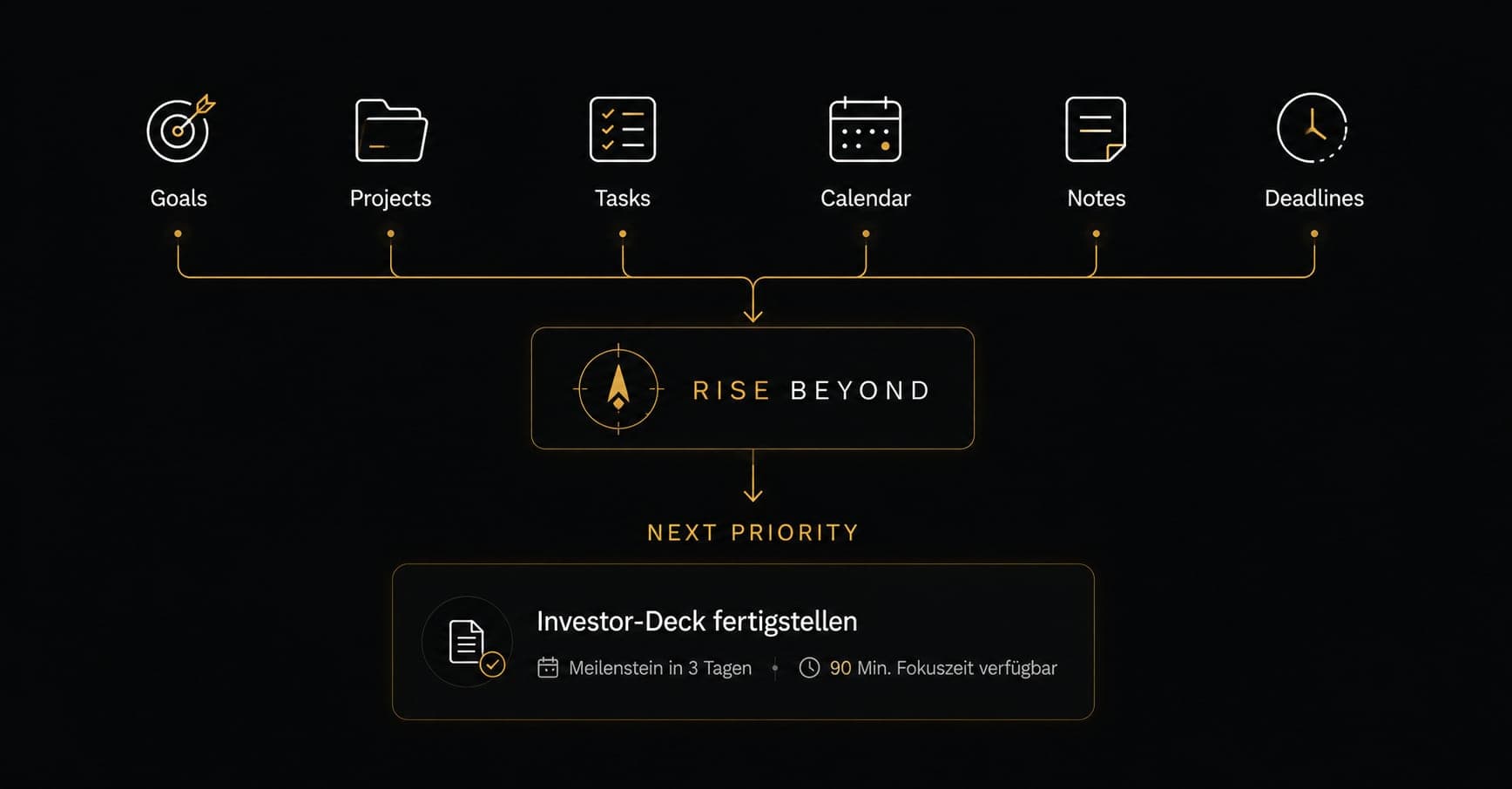
A to-do app for everyday life, a goals document for the big direction — managed separately. This very separation is why tasks end up without meaning and goals without progress.
Many people run two systems in parallel without consciously planning it that way: a to-do app for everyday life and, somewhere, opened less often, a document or note with the actual goals. Both systems run side by side without knowing each other. Over time, the to-do app effectively takes over the role of the priorities system, while the goals quietly fade in a document nobody opens anymore — not out of disinterest, but because nothing in everyday life ever reminds you of it.
Two systems that came about separately
Task management and goal management solve different problems. A to-do list answers what needs to be done next. A goal answers where you want to go in the first place. Both questions are legitimate — but because they arose from different needs, in practice they almost always end up in different tools, without anyone having consciously decided to separate them. Nobody is to blame for this separation — it’s simply the default setting with which most habits and apps arrive for most people.
When task management runs without a goal
Pure task management can feel very efficient: the inbox is empty, every task of the day is checked off, the list for tomorrow is prepared. Still, at the end of the year it may become apparent that precisely the three things that were actually most important haven’t moved a single step — because they never found their way onto the daily list. We have already described this in more detail: a list without a connection to a goal remains arbitrary, no matter how reliably it’s worked through.
When goal management stays without tasks
The reverse mistake is just as common: goals are formulated and occasionally revised — at the turn of the year, at the start of a quarter — but never translated into something that lands on a daily list. Why this happens and why exactly this translation step is decisive, we have covered in a separate article. Without this translation, a goal remains a declaration of intent that never comes into contact with actual everyday life.
Why they only work together
Task management answers what is being done. Goal management answers why it matters. A task list without a link to goals optimizes for busyness. A goal without a link to tasks remains a wish. Only when both levels are connected does a system honestly show where your time actually goes — instead of just how much of it was scheduled. How goals, projects, and tasks structurally interlock, a look at the five levels of a personal system shows.
Not every task needs a goal — but you should know
This doesn’t mean that every single task must be assigned to a goal. Filing tax documents or replying to a request are legitimate tasks without a link to a goal — that’s perfectly fine. What matters is only that it stays visible which tasks serve a goal and which are pure maintenance work. Only this visibility turns the distribution of time into a conscious decision instead of a chance product.
An example: two people, two blind spots
Two people can do the same job and still stand at opposite ends of the same problem. One works through their list reliably every day, responds quickly to requests, comes across as extremely organized — and wonders at the end of the quarter why the new offer they had actually planned still doesn’t exist. The other has a clear idea of their next year and can explain it well — but when you ask about the last concrete task that moved that idea forward, a long pause follows. Both take their work seriously. Both lack the same bridge between the two systems.
The price of two separate systems
Even if both systems work on their own, maintaining them in parallel costs something. Anyone who wants to keep a goal in mind while the actual work is organized in a separate app has to re-establish the connection between the two themselves every time. This translation work doesn’t happen automatically — it costs attention that should actually go to the work itself. The more goals and the more tasks are running at once, the more expensive this constant mental reconciliation becomes, until at some point it simply no longer happens.
How to build this bridge in everyday life
The first step is rarely a new tool, but a single habit: before a new task goes on the list, briefly ask which goal it serves — or consciously accept that it serves none. This one question is often enough to turn a growing list back into a list that actually says something about your priorities, instead of just about your busyness.
One system instead of two separate tools
That is why Rise Beyond doesn’t treat task and goal management as two separate areas, but as one continuous structure: every task can be assigned to a goal, and where that isn’t the case, it stays just as visible as in the reverse case. How this is implemented in practice, the overview of how it works shows.
If you want to experience for yourself how this feels in everyday life, you can apply for early access to Rise Beyond.
Organize less. Act with clarity.
Join the closed beta