Blog
Why weekly planning fails when it isn’t connected to your goals
4 min read
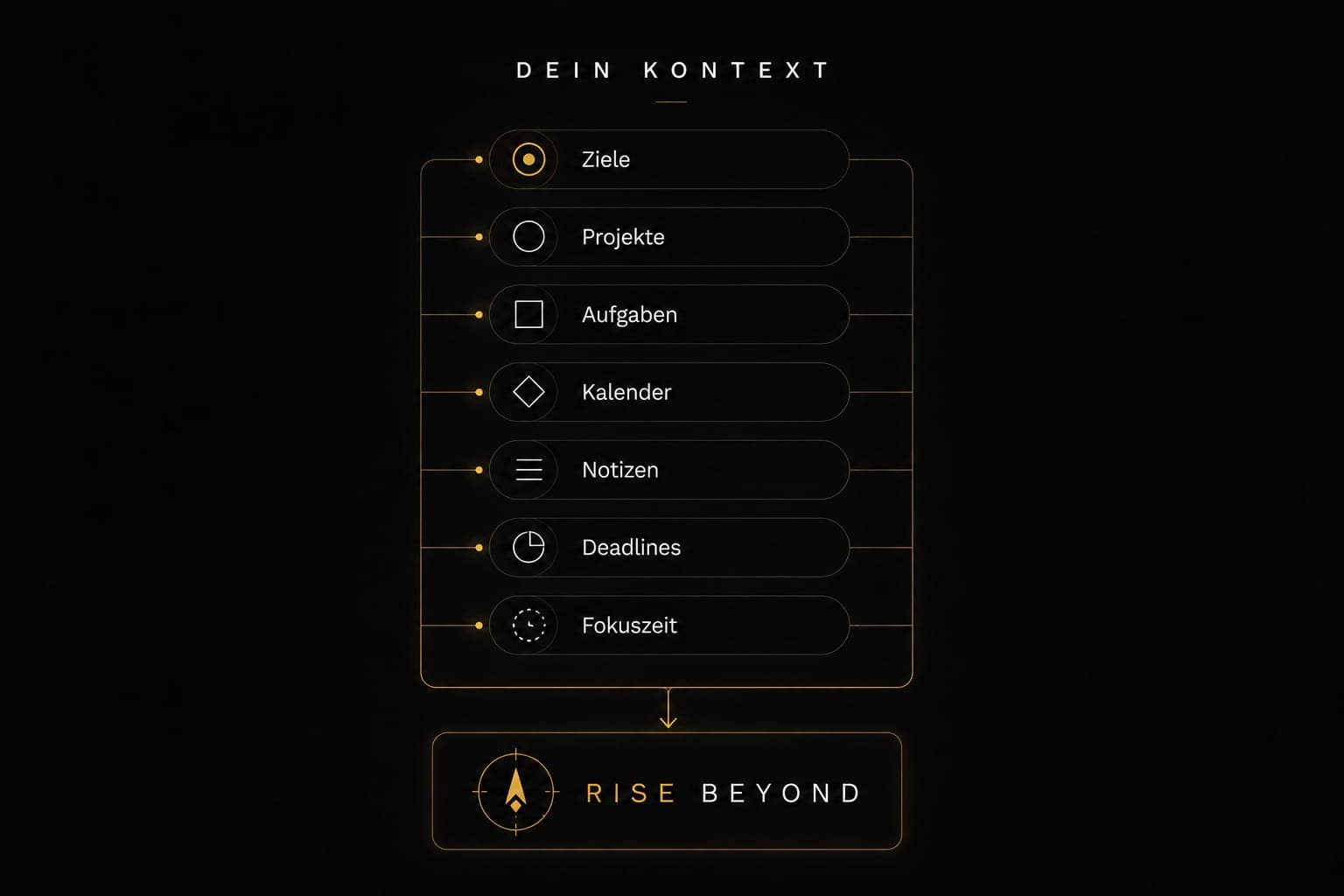
A full week feels productive — and still says nothing about whether it brought you closer to your goal. Without a link to goals and projects, every weekly plan becomes arbitrary.
Monday morning, time to plan the week: enter appointments, distribute open tasks, catch up on a few things from last week. By Friday evening, most of the list is checked off — and yet a vague feeling often remains of not having really made progress. The problem rarely lies in the planning itself, in discipline, or in the tool you chose. It lies in what the weekly plan is connected to — or isn’t.
A weekly plan is initially just a list with a time frame
Spreading tasks across Monday to Friday doesn’t turn them into a plan in the true sense — it only sorts them by time. The list still doesn’t answer why these particular tasks are on the schedule this week and others aren’t. Without that answer, a weekly plan is at its core the same flat collection as an ordinary to-do list, just with weekdays attached.
Why plain task lists don’t make good weekly plans
A list of tasks for the week says what needs to be done. It doesn’t say why it has to be this week. But it’s exactly this second question that decides whether a week ended up moving something or was merely filled. Two weeks can look identically full — with the same sense of busyness — and still be completely different in effectiveness.
Without goals, a week becomes arbitrary
Without a link to a longer-term goal, almost all weeks look structurally similar: emails, ongoing coordination, small requests, a few recurring tasks. None of it is wrong, but none of it distinguishes a good week from one that was merely busy. A self-employed person, for example, can reliably write invoices, answer emails, and handle administrative things every week — and three months later still be no step closer to the new offer that was actually the goal of the quarter. Not because this work is unimportant, but because the real goal never showed up concretely in a single weekly plan. At the end of the quarter, it’s then hard to explain where the time went, even though every single week looked productive on its own.
How goals, projects, and tasks flow into a week
A goal sets the direction, a project translates it into a concrete undertaking — and only from that project do the tasks emerge that are even candidates for being included in a particular week. The week is thus not the first level of planning, but the last: the place where it’s decided which concrete slice of a larger undertaking is up now. How this chain from goal through project to task works in detail, we have already described at length.
Not every important task belongs in this week
Here’s the thing: being important isn’t enough to belong in the current week. A task can be crucial for a goal and still be badly timed right now — for example because a prerequisite is missing or there’s simply no capacity free for it. “Redesign the website” is important as a project, but as long as the basic structure hasn’t been decided, trying to squeeze it into a single week anyway only produces an unfinished, frustrating line on the list. The same distinction, by the way, applies at the daily level — the most important task isn’t automatically the right next one.
What really counts at the end of a week
A weekly plan doesn’t end on Friday just because the list is empty by then. Before planning the next week, a short, honest look back is worthwhile: Did the completed tasks actually move a goal forward — or were they just urgent? This review doesn’t have to be elaborate; a single question is usually enough. Without it, the same pattern of error repeats every week: the list is filled again with whatever is loudest right now, instead of with what should actually bring you closer to a goal since last week.
Creating focus without scheduling your entire life
A good weekly plan doesn’t try to book every hour. A fully scheduled day falls apart at the first unexpected request, and afterward the whole plan feels pointless. It makes more sense to clearly name two or three things per week that truly relate to a goal — and to deliberately give them room — while the rest of the week stays flexible for whatever comes up anyway. It’s the same idea behind fewer competing priorities instead of more time: not planning more, but planning more deliberately.
The mediator between direction and week
A weekly plan works best as a mediator between two levels: the long-term direction (goals and projects) and what is realistically possible this week. That is exactly what Rise Beyond tries to support — goals, projects, calendar, and available time are considered together, so that a week isn’t simply filled with whatever is loudest right now, but with what actually moves a goal forward. What this interplay looks like in practice, the overview of how it works shows.
If you want to experience for yourself how this feels in everyday life, you can apply for early access to Rise Beyond.
Organize less. Act with clarity.
Join the closed beta